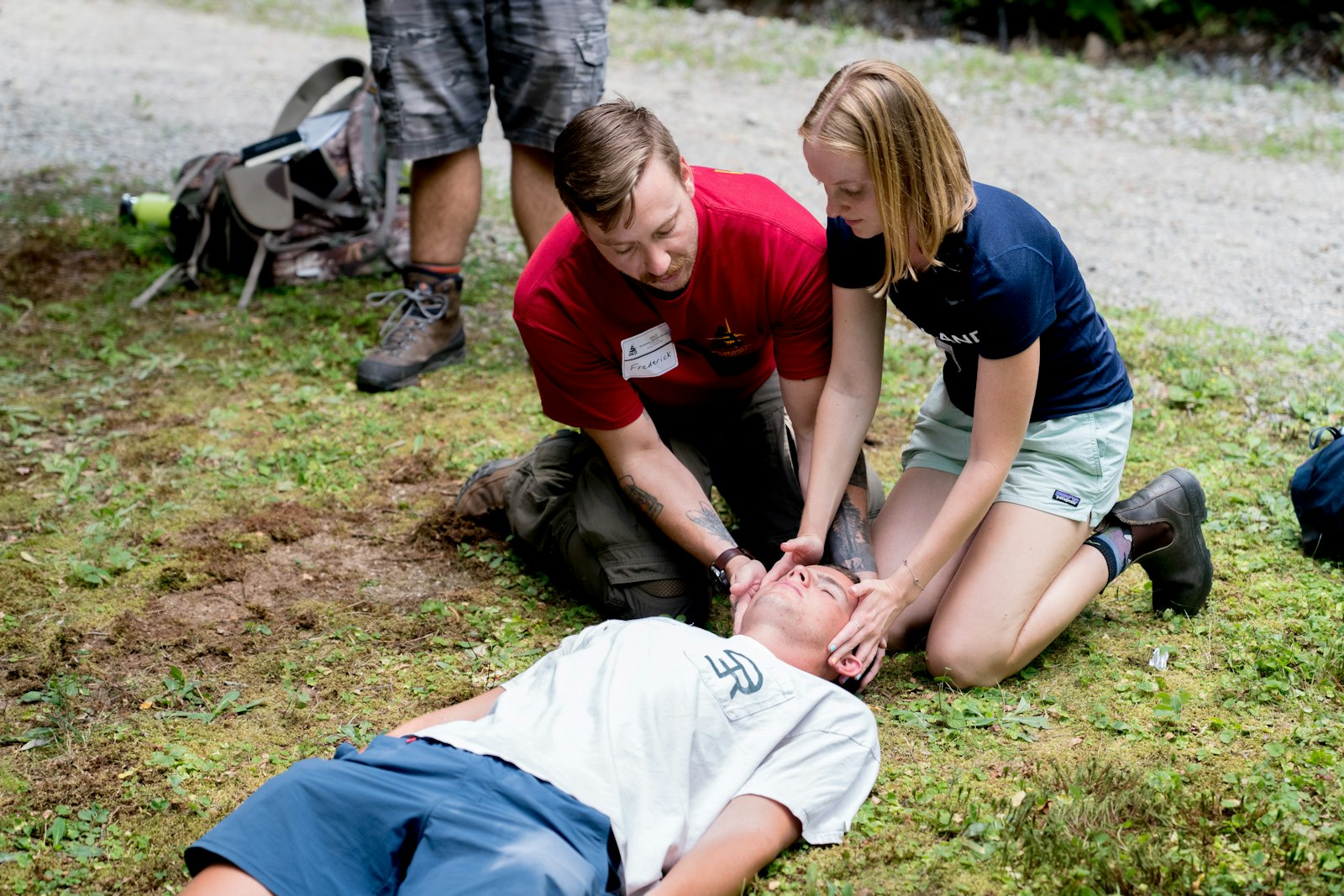
If someone collapses and is unresponsive and not breathing normally, call 999 or 112, put your phone on speaker and start CPR straight away. Push hard and fast in the centre of the chest, about 5–6 cm deep at 100 to 120 compressions a minute. If you are trained and willing, give 2 rescue breaths after every 30 compressions; if not, keep pushing without breaks. Send someone for a defibrillator and use it as soon as it arrives: it talks you through every step.
Updated 12 October 2026 · Sources: St John Ambulance, British Heart Foundation, Resuscitation Council UK
Call 999 or 112 and put the phone on speaker so your hands are free. The call handler will coach you through CPR and can tell you where the nearest registered defibrillator is. Occasional gasps are not normal breathing: start CPR.
CPR in four numbers
Figures from the British Heart Foundation (out-of-hospital cardiac arrests) and St John Ambulance CPR guidance (rate and depth).
How do you know someone needs CPR?
Someone needs CPR if they are unresponsive and not breathing normally. Check it is safe, then gently shake their shoulders and ask loudly if they are OK. If there is no response, tilt the head back and lift the chin, then look, listen and feel for breathing for up to 10 seconds. Irregular gasps are common in early cardiac arrest and are not normal breathing.
How to do CPR on an adult, step by step
1. Check for a response
2. Open the airway and check breathing
3. Call 999 or 112 on speaker
4. Push hard and fast
5. Rescue breaths if trained
6. Keep going
Steps based on St John Ambulance adult CPR guidance. A first aid course teaches the hands-on skill; this guide is a reminder, not a replacement.
What is hands-only CPR?
Hands-only CPR means continuous chest compressions without rescue breaths. St John Ambulance says that if you are unable or unwilling to give rescue breaths, you should give chest compressions without stopping. Pushing hard and fast in the centre of the chest keeps blood and oxygen moving to the brain until a defibrillator or the ambulance arrives.
How do you use a defibrillator?
You don’t need training to use a public defibrillator (AED): it gives spoken instructions. Switch it on, bare and dry the chest, and stick one pad below the right collarbone and the other on the left side below the armpit while someone keeps up CPR. When it analyses or shocks, make sure nobody touches the person, then restart CPR when it tells you to.
Where can you find a defibrillator?
Many public defibrillators are on The Circuit, the national defibrillator network funded by the British Heart Foundation and used by UK ambulance services. When you call 999, the call handler can direct a helper to the nearest registered one. Common places include stations, shopping centres, sports clubs, workplaces and community cabinets. It is worth noticing the one nearest your home or office.
CPR for adults, children and babies: what changes?
All three use 100 to 120 compressions a minute. If you are alone with a child or baby and have no speaker phone, St John Ambulance says to give one minute of CPR before calling 999. Source: St John Ambulance adult, child and baby CPR guidance.
CPR myths vs facts
Cardiac arrest or heart attack: what’s the difference?
A cardiac arrest is when the heart suddenly stops pumping blood around the body: the person collapses, is unresponsive and is not breathing normally, and may make gasping noises. They need CPR and a defibrillator. A heart attack is a different problem, though the British Heart Foundation lists it as one possible cause of cardiac arrest. If someone has chest pain but is awake and breathing, call 999; CPR is only for someone unresponsive and not breathing normally.
Can you get in trouble for doing CPR?
Resuscitation Council UK says there has been no reported successful claim against a bystander who tried CPR or used a defibrillator, and that liability would only arise if the intervention left the person worse off, which is highly unlikely. In England and Wales, the Social Action, Responsibility and Heroism Act 2015 also asks courts to consider that you acted to help in an emergency.
Frequently asked questions
Keep going until emergency help arrives and takes over, the person shows signs of life and breathes normally, a defibrillator is ready to use, or you are too exhausted to continue. If someone else can help, St John Ambulance advises swapping every 1 to 2 minutes with as little pause as possible.
No. If you are not trained or don’t want to give rescue breaths, St John Ambulance advises continuous chest compressions without breaths. If you are trained and willing, give 2 rescue breaths after every 30 compressions.
Learn the next steps too: the recovery position for someone who is breathing, how to tell 999 exactly where you are, how to make a silent 999 call, how to set up Emergency SOS on your phone, and how to check someone’s Medical ID on a locked phone. Not sure which number to ring? See which number should I call.
Sources
- St John Ambulance: how to do CPR on an adult
- St John Ambulance: how to use a defibrillator (AED)
- St John Ambulance: CPR on a child
- St John Ambulance: CPR on a baby
- British Heart Foundation: out-of-hospital cardiac arrests
- British Heart Foundation: cardiac arrest
- The Circuit: the national defibrillator network
- Resuscitation Council UK: CPR, AEDs and the law
General first aid information, not medical advice, and no substitute for a first aid course. In an emergency, always call 999.
Keep reading
In an emergency, every second counts: get your circle there fast
Safety App UK lets you trigger an SOS by button or shake, or automatically in higher-crime zones, sending your live location and live video to a trusted circle so the people you choose know where you are. Its live safety map, built from police data and community reports, shows police stations and Ask for Angela venues and helps you plan safer routes. It does not call the emergency services, so if someone needs CPR, always dial 999 first. Free for 7 days, then £2.99 a month. For ages 16+.